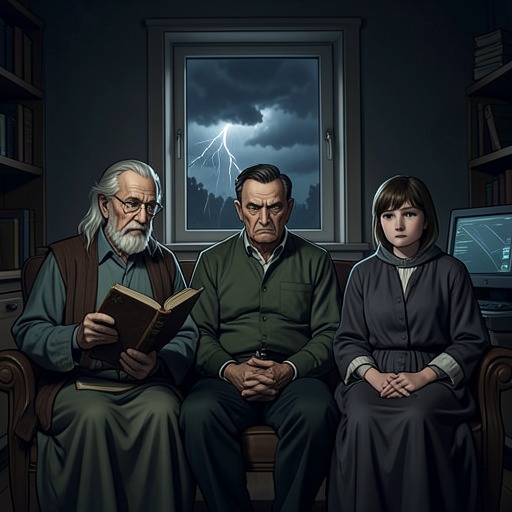
Ray’s threat to tape Thomas’s hands
I Know This Much Is TrueRay’s threat to tape Thomas’s hands is a childhood scene of threatened punishment that reveals how quickly an ordinary reprimand in the Birdsey household can become physical intimidation. After catching Thomas chewing his sleeve, Ray reaches for his belt, rebukes Ma for intervening, and returns with tape. Dominick Birdsey recalls the episode through sharp sounds and comparisons to trapped or choked animals; Thomas’s repeated apologies give the scene its human cost, while the threat itself remains unresolved in the passage.
The Incident at Supper
The episode begins at supper, when Ray catches Thomas chewing on his sleeve. Ray’s “Okay! That’s it!” marks the moment as more than a casual correction: his abrupt declaration turns the behavior into a provocation requiring punishment. He stands, pulls off his belt, loops it, and snaps it against the table. The sequence is described through visible actions and a sound that recurs, so the threat gathers force before Ray has touched Thomas. Dominick’s attention moves from the belt to the memory of rats running through a dark basement and encountering traps; the comparison makes the snapping sound part of a larger image of animals cornered by danger.
Ma tries to interrupt with “Come on, now, Ray,” but her appeal does not de-escalate him. Ray points at her and tells her to stay out of it, calling her “Suzie Q.” He blames Thomas’s behavior on what he considers Ma’s excessive indulgence, saying that if she did not “namby-pamby him all the time,” Thomas would not be like this. The accusation redirects attention from Ray’s choice to threaten punishment toward Ma’s supposed failure to discipline her son. His words therefore do more than express anger: they attempt to close off her intervention and establish his authority over what happens next.
From Belt to Tape
Ray throws the belt down and goes to the cellar. That change of object does not end the threat. He comes back upstairs with a roll of tape and turns to Dominick, telling him, “Am-scray!” The gesture draws Dominick out of the immediate scene, but it also makes him a witness: Ray directs him away just as the punishment is about to continue beyond his view. The excerpt does not say that Ray actually binds Thomas’s hands, and the distinction matters. What it records is a credible threat, reinforced by the belt, the tape, and Ray’s command—not a confirmed act of taping.
Once outside, Dominick hears Thomas crying, choking, and struggling to breathe. The narration compares the sound to a dog trying to breathe while Mr. Grymkowski pulled its collar. This remembered image links Thomas’s distress to another scene of an animal restrained, but the comparison does not make Thomas’s experience figurative or distant: his crying is audible from the backyard, while the exact actions taking place remain out of Dominick’s sight. The sound carries the threat across that separation.
Thomas’s Pleas and the Scene’s Ending
Thomas repeatedly apologizes to Ray and begs him not to tape his hands. His plea, “Don’t tape my hands up, please!” names the danger that Ray’s return with the tape has created. Thomas also says he forgot and keeps apologizing, making his fear audible as an effort to placate Ray. The excerpt gives no independent explanation of what Thomas forgot, so his words establish his distress without clarifying the original cause beyond the sleeve-chewing that Ray observed at supper.
The scene does not close with an account of what Ray ultimately does. Instead, Dominick’s recollection widens to the backyard night: mosquitoes, two bats crossing the streetlight, and an airplane’s red lights blinking overhead. These details place Thomas’s cries within an ordinary outdoor setting, without resolving the danger that produced them. Dominick then recalls the ending of The Wizard of Oz, where the Wicked Witch melts and the spell breaks, and the flying monkeys become nice; he adds that they were men, not monkeys. The shift to the film’s transformation offers a contrast to the unresolved punishment: in the remembered movie, the threat lifts and the frightening figures change, but this passage gives no equivalent release for Thomas.
Narrative and Thematic Significance
The scene is narrated by Dominick as a memory, and its limited vantage shapes what can be known. He sees Ray brandish the belt, hears him blame Ma, watches him return with tape, and then hears Thomas from outside. The account does not supply a later explanation or confirm the precise punishment. Its power comes instead from the sequence of threat, attempted intervention, dismissal, and frightened pleading. That sequence shows a household in which an adult’s authority can silence another adult while leaving a child to bargain through apologies.
The episode also establishes a contrast between what is seen and what is heard. Ray’s actions with the belt and tape are directly visible; Thomas’s distress is heard from the backyard, where the narrator compares it to an animal being choked. The repeated snaps first make the threat sound like a trap closing, while Thomas’s breathing turns the image of entrapment into a bodily consequence. By ending on the movie’s broken spell rather than on an account of the punishment, the recollection leaves the difference between imagined rescue and domestic fear in view. It records not only Ray’s threat, but also the uncertainty and helplessness from which Dominick witnesses it.